Parametrization
The Log-Logistic distribution for a random vector \(\pmb{y} = (y_1, y_2, \ldots, y_n)\), where each \(y_i > 0\), has two parameterization variants.
Variant 0 (default):
\[F_0(y_i) = \frac{1}{1 + \lambda_i y_i^{-\alpha}}, \quad y_i > 0\]
Variant 1:
\[F_1(y_i) = \frac{1}{1 + (\lambda_i y_i)^{-\alpha}}, \quad y_i > 0\]
where:
\(\pmb{y} = (y_1, y_2, \ldots, y_n)\) represents the observed positive continuous response values.
\(\alpha > 0\) is the shape parameter, controlling the tail behavior of the distribution.
\(\lambda_i > 0\) is the scale parameter for observation \(y_i\), linked to the linear predictor.
The corresponding probability density functions (PDF) are:
Variant 0:
\[f_0(y_i) = \frac{\alpha \lambda_i y_i^{-\alpha - 1}}{(1 + \lambda_i y_i^{-\alpha})^2}, \quad y_i > 0\]
Variant 1:
\[f_1(y_i) = \frac{\alpha (\lambda_i y_i)^{-\alpha} \lambda_i}{(1 + (\lambda_i y_i)^{-\alpha})^2}, \quad y_i > 0\]
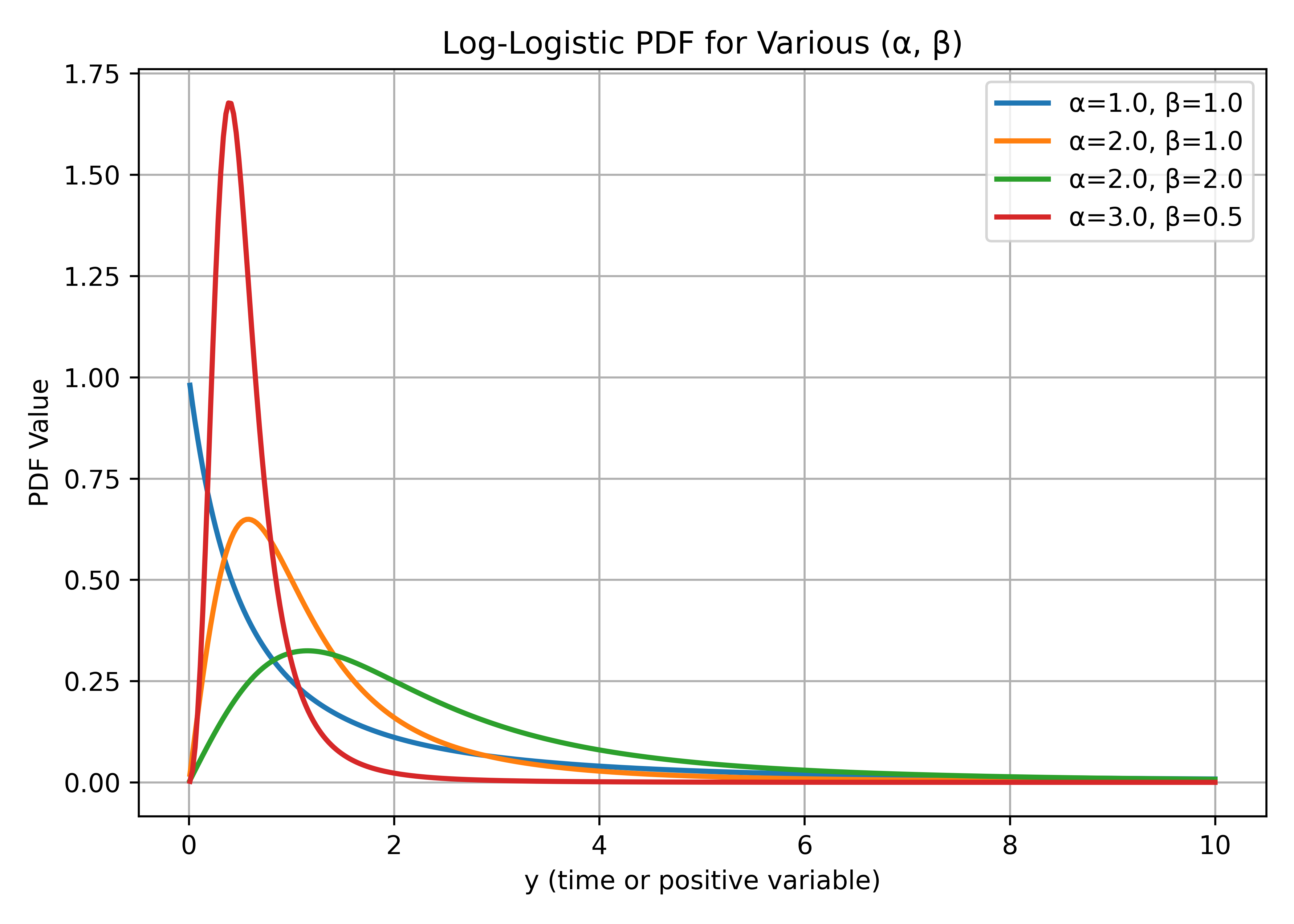
Figure 1 illustrates how the Log-Logistic PDF changes for different shape (\(\alpha\)) and scale parameters.
Mean and Variance
The mean and variance of \(y_i\) exist only for certain ranges of the shape parameter \(\alpha\):
Mean: Exists if \(\alpha > 1\): \[\text{E}(y_i) = \lambda_i^{1/\alpha} \cdot \frac{\pi/\alpha}{\sin(\pi/\alpha)}\]
Variance: Exists if \(\alpha > 2\) and involves higher-order moment expressions.
For small values of \(\alpha\), the distribution has very heavy tails and the moments may not exist.
Link Function
The scale parameter \(\lambda_i\) is linked to the linear predictor \(\eta_i\) using the log link (default):
\[\lambda_i = \exp(\eta_i), \quad i = 1, 2, \ldots, n\]
In vector form:
\[\pmb{\lambda} = \exp(\pmb{\eta})\]
Available link functions: default, log, neglog.
Hyperparameters
The Log-Logistic likelihood has one hyperparameter controlling the shape \(\alpha\). This hyperparameter appears as a log-transformed parameter to ensure it remains within valid (positive) ranges and to improve numerical stability during inference.
Hyperparameter \(\theta\) (shape)
The default configuration assigns a loggamma prior to \(\theta\) with parameters \((25, 25)\). The initial value is set to \(\theta = 1\) (corresponding to \(\alpha \approx 2.72\)).
Key: alpha
The shape parameter \(\alpha\) is represented internally as \(\theta = \log(\alpha)\), so \(\theta\) can take any real value while ensuring \(\alpha > 0\). The prior is defined on \(\theta\).
When translated into control['family']['hyper'], the default entry is:
control = {
    'family': {
        'variant': 0,  # or 1
        'hyper': [{
            'id': 'alpha',
            'prior': 'loggamma',
            'param': [25, 25],
            'initial': 1,
            'fixed': False,
        }]
    }
}
Each entry in control['family']['hyper'] may contain these keys:
id- Hyperparameter identifier (alpha). Can be omitted for the first (and only) hyperparameter.prior- Prior distribution nameparam- Prior parameters (list)initial- Initial value on log scalefixed- Whether to fix the hyperparameter (True/False)
The shape hyperparameter (alpha) accepts any prior from the prior registry. The most commonly useful choices on \(\theta = \log(\alpha)\) are:
| Prior | Param shape | Use when |
|---|---|---|
loggamma (default) | [shape, rate], both positive | Conjugate prior on the log-shape; default is [25, 25]. |
pc.prec | [U, alpha] with P(sd > U) = alpha | Penalised-complexity prior. |
normal / gaussian | [mean, precision] on \(\theta\) | Soft Gaussian prior on the log-shape. |
flat | [] | Improper flat. Pass param=[] explicitly. |
logtnormal | [location, scale] | Truncated-normal on \(\theta\). |
The shape can also be pinned at a known value by setting fixed=True (no prior required). Unknown prior names raise a clear pyinla safety check: unknown prior '...' error before the engine runs; wrong param length similarly trips a safety error.
Validation Rules
pyINLA enforces several validation rules for Log-Logistic models to ensure correct specification:
Not Allowed Arguments
The following arguments are not allowed for loglogistic and will raise PyINLAError:
E(exposure) - Only allowed for poisson/nbinomialscale- Only allowed for gaussian/nbinomial/xbinomial/gamma/beta/logistic/tNtrials- Only allowed for binomial/xbinomial/betabinomial/nbinomial2
Hyperparameters
Key: control['family']['hyper']
When configuring hyperparameters (see the Hyperparameters section above for the full prior registry and key listing):
If
prioris omitted, the schema default is used (loggammawithparam=[25, 25]); a fixed entry can also omitpriorandparam.If specified, the prior name must be in the registry. Unknown names raise
pyinla safety check: unknown prior.paramlength must match the prior's expected count.
Variant
Key: control['family']['variant']
The variant parameter is allowed and must be:
0(default)1
Allowed Link Functions
Key: control['family']['link']
For loglogistic:
defaultlogneglog
For loglogisticsurv:
defaultlogneglog
Response Values
Response variable \(\pmb{y}\) must be strictly positive (\(y_i > 0\)). pyINLA will raise PyINLAError if any response value is zero or negative.
Survival Response
When using loglogisticsurv, the response must be created using inla_surv():
from pyinla import inla_surv

# Create survival response (event=1 observed, event=0 right-censored)
y_surv = inla_surv(time=df["time"], event=df["event"])
result = pyinla(model={'response': y_surv, 'fixed': ['1', 'x']},
                family="loglogisticsurv", data=df)
inla_surv supports the following censoring types:
- Right censoring: the event has not occurred by the end of observation; only a lower bound on the survival time is known.
- Left censoring: the event occurred before observation began; only an upper bound is known.
- Interval censoring: the event is known to have occurred within a known time interval.
Survival-only Hyperparameters (cure model)
In addition to the shape alpha (which both forms share),
loglogisticsurv exposes 10 cure-model regression coefficients
beta1, ..., beta10 (positional aliases
theta2, ..., theta11). The default priors are
\(\text{Normal}(-4, 100)\) on
beta1 (initial \(-5\)) and
\(\text{Normal}(0, 100)\) on
beta2, ..., beta10 (initial \(0\)).
These are only active when a cure structure is configured; most survival
users leave them at the defaults and configure only the alpha slot.
Specification
family="loglogistic"for regression modelsfamily="loglogisticsurv"for survival models with censoringRequired arguments:
For regression: \(\pmb{y}\) where \(y_i > 0\).
For survival:
inla_surv(time, event)object.
Optional:
variant(0 or 1, default = 0).
Notes
- The Log-Logistic distribution has heavier tails than the log-normal, making it useful for modeling survival times with hazard rates that increase initially and then decrease.
- Two variant parameterizations are available (
variant=0orvariant=1), choose the one that matches your data generation process. - The survival model (
loglogisticsurv) supports right censored, left censored, and interval censored data through theinla_survobject. - If observed times are very large, consider scaling them to avoid numerical overflow issues.
- The hazard function of the log-logistic is non-monotonic when \(\alpha > 1\), first increasing and then decreasing.