Gaussian Regression: Precision Offset
A tutorial on incorporating a fixed, known variance component into a Gaussian regression model using the precision offset.
Introduction
In this tutorial, we fit a Bayesian linear regression model where part of the observation variance is known a priori. This is common when measurements have a known instrument error or when combining data sources with different reliability levels.
The precision offset in pyINLA allows us to fix a known variance component while still estimating the remaining unknown variance from the data.
The Model
We consider a linear regression model where the total observation variance is the sum of two components:
where the total variance decomposes as:
Here:
- $\sigma^2_0 = 1/\tau_0$ is the known variance component (e.g., measurement error)
- $\sigma^2_1 = 1/\tau_1$ is the unknown variance to be estimated
- $\tau_0$ is the precision offset (fixed)
- $\tau_1$ is the precision parameter (estimated)
Linear Predictor
The linear predictor $\eta_i$ links the mean of the response to the covariates:
For the Gaussian likelihood with identity link:
Likelihood Function
The effective precision of each observation combines both components. In pyINLA's parameterization:
The likelihood for observation $y_i$ is:
When $\tau_0$ is fixed at a known value, only $\tau_1$ is estimated from the data.
The Precision Offset
The precision offset $\tau_0$ is specified on the log scale as $\theta_0 = \log(\tau_0)$. Given a known variance $\sigma^2_0$, we compute:
Example: For a known variance of $\sigma^2_0 = 1.0$:
This value is passed to pyINLA via 'id': 'precoffset' with 'fixed': True.
Dataset
The dataset contains $n = 100$ observations with two columns:
| Column | Description | Type |
|---|---|---|
y | Continuous response variable | float |
x | Covariate (predictor variable) | float |
Download the CSV file and place it in your working directory.
Implementation in pyINLA
We fit the model by specifying the precision offset as a fixed hyperparameter:
- Define the known variance component $\sigma^2_0$
- Convert to log precision: $\theta_0 = \log(1/\sigma^2_0)$
- Pass to
control['family']['hyper']with'id': 'precoffset' - Set
'fixed': Trueto keep it constant
import math
import pandas as pd
from pyinla import pyinla

# Load data
df = pd.read_csv('dataset_gaussian_offset.csv')

# Known variance component
var0 = 1.0  # known measurement variance

# Define model: y ~ 1 + x (intercept + slope)
model = {
    'response': 'y',
    'fixed': ['1', 'x']
}

# Specify the precision offset (fixed)
control = {
    'family': {
        'hyper': [{
            'id': 'precoffset',
            'initial': math.log(1.0 / var0),  # log(tau_0) = log(1/var0)
            'fixed': True
        }]
    },
    'predictor': {'compute': True}  # enables fitted values
}

# Fit the model
result = pyinla(
    model=model,
    family='gaussian',
    data=df,
    control=control
)

# View posterior summaries for fixed effects
print(result.summary_fixed)
Extracting Results
The result object contains posterior inference for the estimated parameters:
# Fixed effects: posterior summaries for beta_0 and beta_1
print(result.summary_fixed)

# Extract posterior means
intercept = result.summary_fixed.loc['(Intercept)', 'mean']
slope = result.summary_fixed.loc['x', 'mean']

# Fitted values: posterior mean of eta_i
fitted_means = result.summary_fitted_values['mean'].to_numpy()

# Compute residuals
residuals = df['y'].to_numpy() - fitted_means

# Hyperparameters: posterior summary for estimated precision tau_1
print(result.summary_hyperpar)

# Marginal posterior density for tau_1 (for plotting)
density = result.marginals_hyperpar['Precision for the Gaussian observations']
Note: The precision offset $\tau_0$ is fixed, so only $\tau_1$ appears in the hyperparameter summaries.
Results and Diagnostics
The posterior summaries provide estimates for $\beta_0$, $\beta_1$, and the unknown precision $\tau_1$.
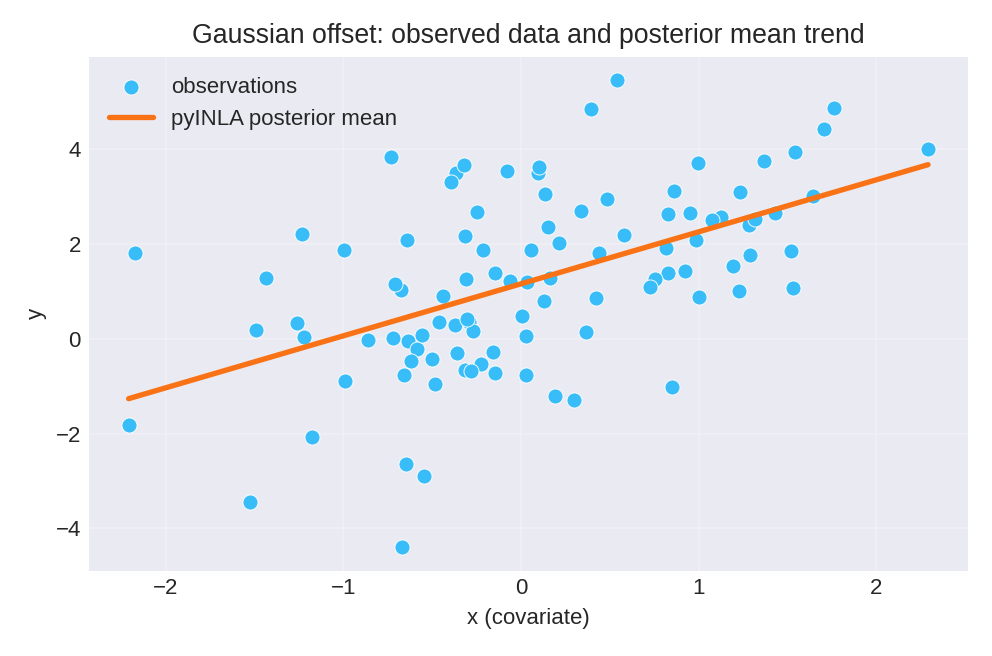
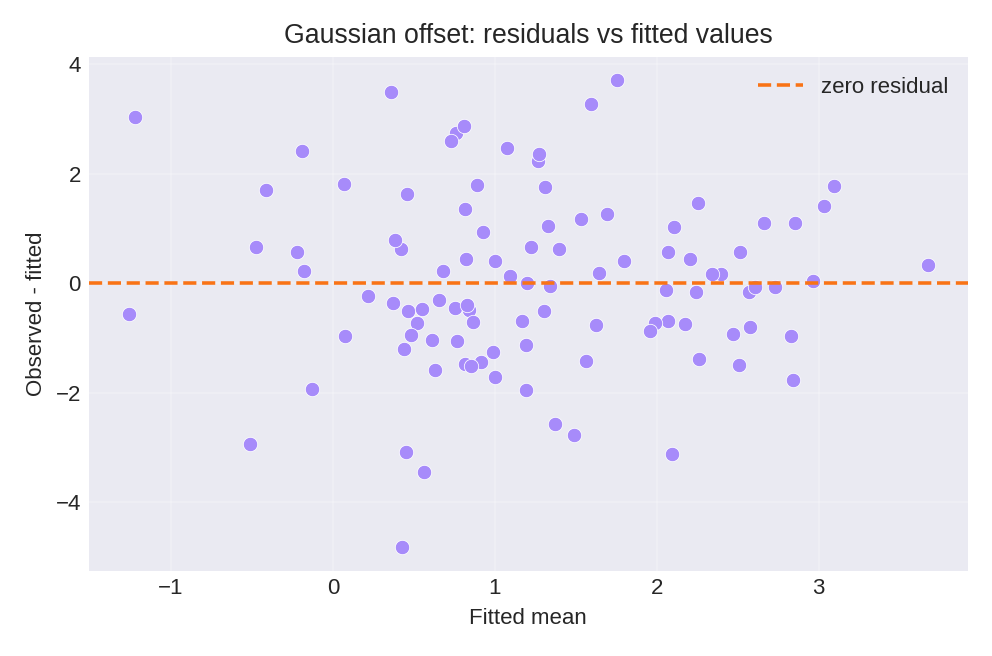
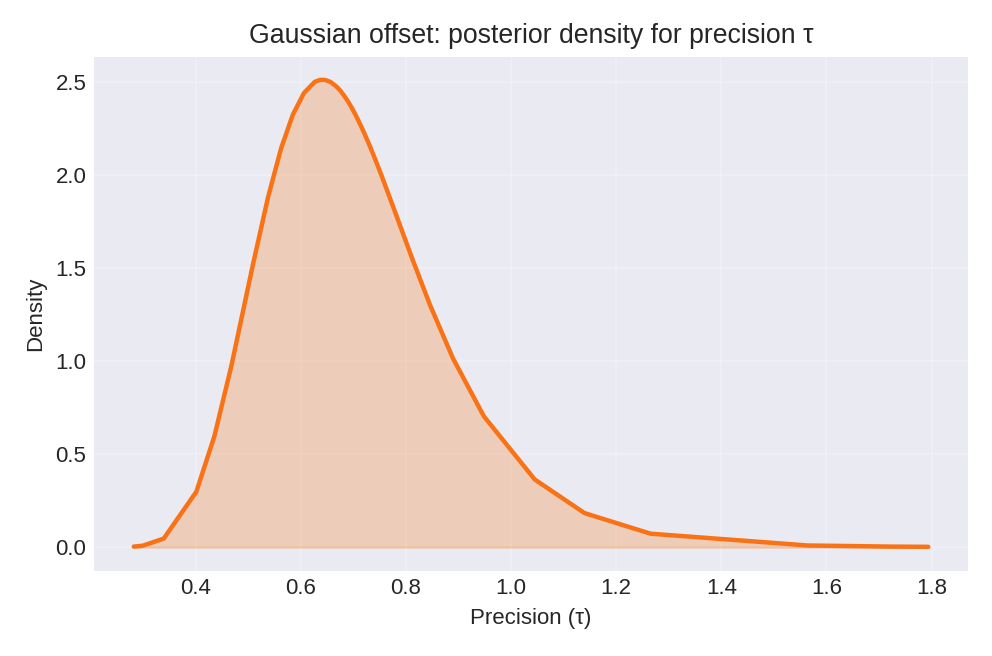
To reproduce these figures locally, download the render_gaussian_plots.py script and run it alongside the CSV dataset.
Data Generation (Reference)
For reproducibility, the dataset was simulated from the following data-generating process:
with true parameter values: $\beta_0 = 1$, $\beta_1 = 1$, $\sigma^2_0 = 1.0$ (known), $\sigma^2_1 = 2.0$ (to be estimated).
# Data generation script (for reference only)
import numpy as np
import pandas as pd

rng = np.random.default_rng(123)
n = 100
beta0, beta1 = 1.0, 1.0
var0 = 1.0  # known (fixed) variance component
var1 = 2.0  # unknown variance component (to be estimated)

x = rng.normal(size=n)
total_sd = np.sqrt(var0 + var1)  # sqrt(3.0) ≈ 1.73
epsilon = rng.normal(scale=total_sd, size=n)
y = beta0 + beta1 * x + epsilon

df = pd.DataFrame({'y': y, 'x': x})
# df.to_csv('dataset_gaussian_offset.csv', index=False)