pyINLA exposes two exponential families:
exponential for plain regression on positive responses and
exponentialsurv for survival models with censoring. Both share the
same parameterization. exponential has no hyperparameters;
exponentialsurv additionally exposes up to 10 cure-model regression
coefficients (beta1, ..., beta10) which are only active
when a cure structure is configured. The two families differ in the response
object they expect and the link functions they accept.
Parametrization
The probability density function (PDF) for the exponential distribution, considering \(\pmb{y}\) as a vector of responses, is given by:
\[f(y_i \mid \lambda_i) = \lambda_i \exp(-\lambda_i y_i), \quad y_i > 0, \; \lambda_i > 0, \; i = 1, 2, \dots, n,\]
where:
\(\pmb{y} = (y_1, y_2, \ldots, y_n)\) represents the observed response times.
\(\pmb{\lambda} = (\lambda_1, \lambda_2, \ldots, \lambda_n)\) represents the rate parameters for each observation.
In survival analysis, models are often specified through the hazard function. For the exponential model, the baseline hazard is constant over time, and the hazard function is:
\[h(y_i) = \lambda_i, \quad i = 1, 2, \ldots, n.\]
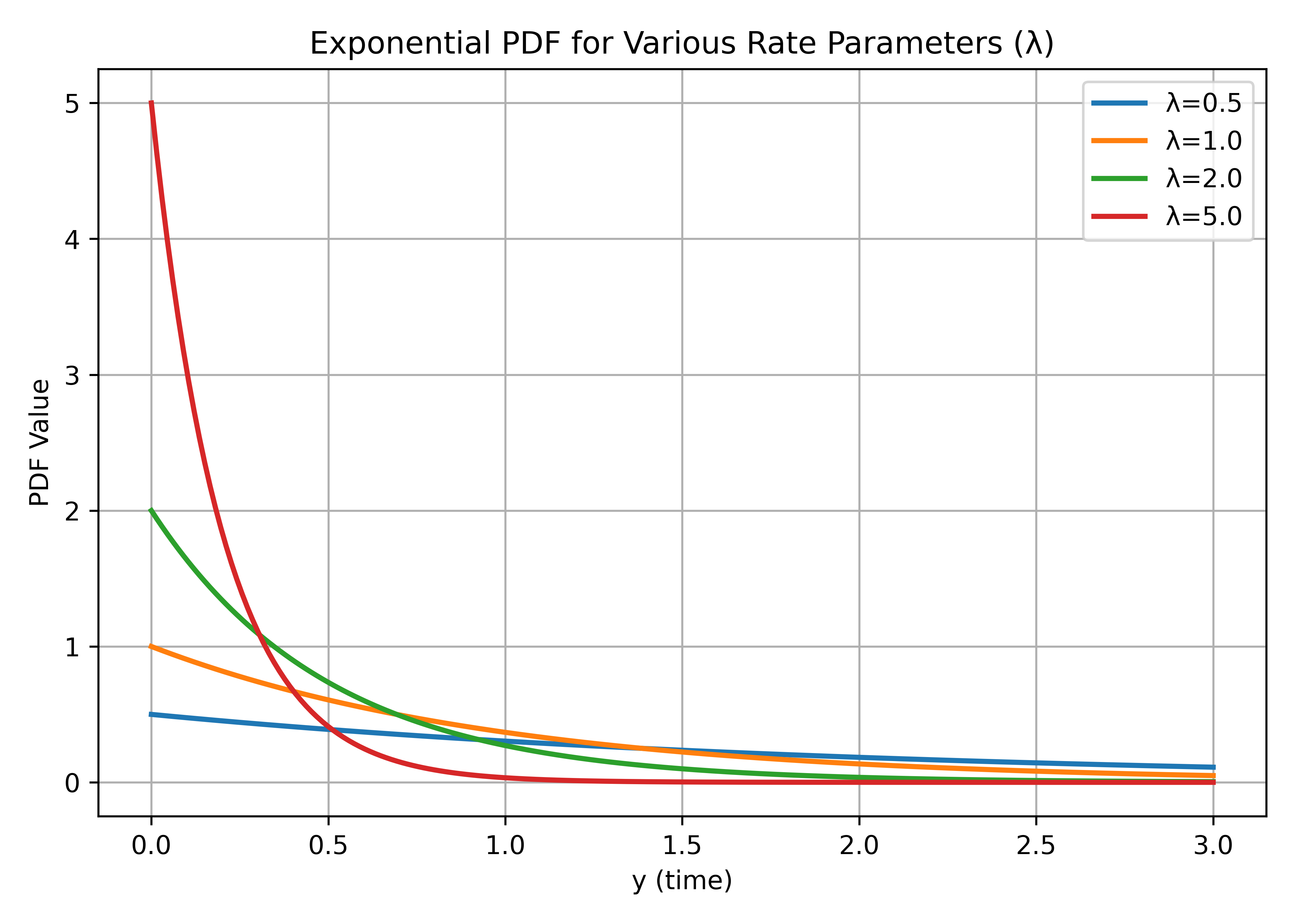
Assume \(n\) = 1. To demonstrate the shape of the Exponential distribution for various rate parameters \(\lambda\), Figure 1 displays several Exponential PDFs.
Link Function
The rate parameter \(\lambda_i\) is linked to the linear predictor \(\eta_i\) using the default log link:
\[\lambda_i = \exp(\eta_i), \quad i = 1, 2, \ldots, n.\]
Available link functions depend on the model variant:
- Regression (
exponential):default,log - Survival (
exponentialsurv):default,log,neglog
The neglog link, available in survival models, corresponds to the accelerated failure time (AFT) parameterization:
\[\lambda_i = \exp(-\eta_i),\]
where positive coefficients increase expected survival times.
Hyperparameters
The exponential likelihood has no hyperparameters:
the rate parameter \(\lambda\) is fully
determined by the linear predictor \(\eta\)
through the link function. Supplying control['family']['hyper']
raises pyinla safety check: control['family']['hyper'] is only allowed
for ....
The exponentialsurv likelihood additionally exposes up to 10
cure-model regression coefficients (beta1, ..., beta10;
positional aliases theta1, ..., theta10). These default
to \(\text{Normal}(-1, 100)\) on beta1
(initial \(-4\)) and
\(\text{Normal}(0, 100)\) on the rest, and
are only active when a cure structure is configured via R-INLA's cure
control block. Most survival users do not need to override these.
Validation Rules
pyINLA enforces several validation rules for Exponential models to ensure correct specification:
No Hyper Configuration (regression form)
Plain exponential has no hyperparameters: providing
control['family']['hyper'] raises PyINLAError. The
exponentialsurv form does accept hyper entries for its cure-model
betas (see Hyperparameters above), but most users leave the defaults in place.
Not Allowed Arguments
The following arguments are not allowed for exponential likelihoods and will raise PyINLAError:
E(exposure) - Only allowed for poisson/nbinomialscale- Only allowed for gaussian/nbinomial/xbinomial/gamma/beta/logistic/tNtrials- Only allowed for binomial/xbinomial/betabinomial/nbinomial2control['family']['variant']- Not supported for exponential or exponentialsurv
Allowed Link Functions
Key: control['family']['link']
For exponential:
defaultlog
For exponentialsurv:
defaultlogneglog
Response Values
For exponential, the response variable \(\pmb{y}\) must be strictly positive (\(y_i > 0\)). pyINLA raises PyINLAError if any response value is zero or negative.
Survival Response
When using exponentialsurv, the response must be created using inla_surv():
from pyinla import inla_surv

# Create survival response (event=1 observed, event=0 right-censored)
y_surv = inla_surv(time=df["time"], event=df["event"])
result = pyinla(model={'response': y_surv, 'fixed': ['1', 'x']},
                family="exponentialsurv", data=df)
inla_surv supports the following censoring types:
- Right censoring: the event has not occurred by the end of observation; only a lower bound on the survival time is known.
- Left censoring: the event occurred before observation began; only an upper bound is known.
- Interval censoring: the event is known to have occurred within a known time interval.
Specification
family="exponential"for regression modelsfamily="exponentialsurv"for survival models- Required arguments:
- For
exponential: \(\pmb{y}\) (response vector of strictly positive values) - For
exponentialsurv: \(\pmb{y}\) provided viainla_surv(time, event)
- For
Model Comparison
| Form | Family | Response | Links |
|---|---|---|---|
| Regression | exponential | plain y (strictly positive) | default, log |
| Survival | exponentialsurv | inla_surv(time, event) | default, log, neglog |